
Marketing teams pay for impressions everywhere — ads, sponsorships, newsletters — while ignoring the channel they already own outright: the ordinary 1:1 email. Your company sends thousands of them a month. They land in inboxes of customers, prospects and partners, they get opened at rates broadcast email can only dream about, and the space under each message costs exactly nothing. Email signature marketing is the practice of putting that space to work.
Why the signature slot outperforms
- Near-100% open context. A 1:1 email from a colleague gets read; newsletters average 20–30% opens on a good day.
- Warm audience. The recipient already knows the sender — trust that display ads spend years buying.
- Zero marginal cost. The emails are sent anyway; the banner rides along free.
- Frequency without fatigue. Each conversation re-exposes the campaign naturally, without another mass send.
- Always on. A campaign in the signature works every business hour of every day.
Think of it as owned media: a network of small, perfectly targeted ad slots — one under every employee's name.
What to run in the slot
One focused creative at a time, rotated like any other channel:
- Events and webinars — registration links in the weeks before.
- Content launches — a new report, case study or product update.
- Product CTAs — book a demo, start a trial, view pricing.
- Hiring — "We're hiring engineers" under every engineer's emails.
- Proof — awards, G2 badges, review links in renewal season.
Target by team, not by blast
The channel gets sharper when segments see different campaigns. Sales signatures carry the meeting-booking banner; customer success promotes the product webinar; recruiters show open roles. Same mechanic as ad audiences — except you already know exactly who every "impression" comes from.
Rotate and test like a real channel
Static banners go stale and invisible. Schedule campaigns with start and end dates so they retire themselves, and run A/B variants of the creative to learn which message pulls. Even modest volumes produce significant results within weeks because the audience and context are so consistent.
Measure it or it didn't happen
Every signature link should be wrapped and tracked. The metrics that matter:
- Clicks per campaign — the headline number, comparable across creatives.
- Click-through by segment — which teams' conversations drive action.
- Device and geography — when and where your banners get acted on.
- Auto-UTM tagging — so signature traffic shows up properly attributed in your analytics, not as "direct".
The workflow in practice
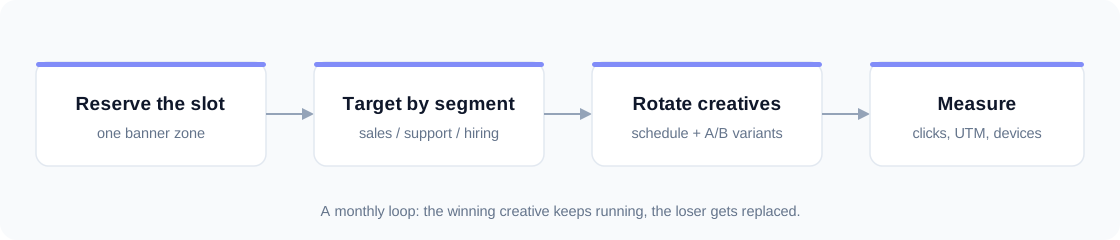
1. Reserve the slot
One banner zone in every template, sized for email (light file, ~600px wide max, solid background).
2. Brief it monthly
Treat it like a paid placement: one campaign per audience per period, one clear call to action.
3. Swap centrally
Creatives change in the platform, not in mailboxes — every signature updates at once, including ones already deployed.
4. Review the numbers
Monthly: clicks by campaign and segment, winner keeps running, loser gets replaced.
Best practices
- One call to action per banner — two halves the result.
- Keep the signature itself clean; the banner is the only promotional element.
- Cap banner height so threads stay readable; use a compact reply signature without the banner.
- Refresh creatives at least monthly to avoid banner blindness.
- Coordinate with the sales team — their conversations are your placements.
Run it with GraceMark
GraceMark turns this playbook into a workflow: campaign banners scheduled with start/end dates, A/B rotation between creatives, segment targeting, automatic UTM tagging and click analytics by campaign, device and location — on top of centrally managed signatures for Microsoft 365 and Google Workspace.
Frequently asked questions
Won't banners make our emails look like ads?
Not if the signature stays clean and the banner is one tasteful creative with a single CTA. The line to avoid is multiple competing promotions in one footer.
How do we measure revenue impact?
Tracked links with auto-UTM flow into your analytics like any campaign source — pipeline touched by signature clicks is fully attributable.
Should every employee carry campaigns?
Usually external-facing teams. Keep executives and legal on minimal layouts, and exclude internal-only roles — segment targeting makes this trivial.
How fast does it show results?
Clicks appear the first day; meaningful comparisons take two to four weeks per creative at typical sending volumes.